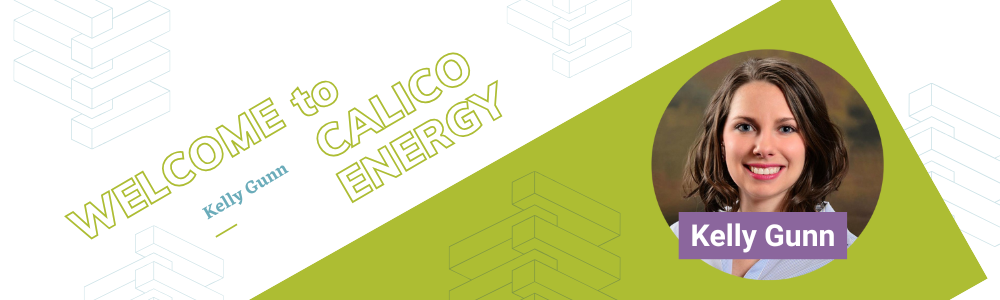
A Special Building Baselines Edition Featuring Calico's Kelly Gunn

Today, we’re excited to introduce the final Building Baselines interview of 2025, featuring one of the newest members of our team: Kelly Gunn, Client Services Strategist. As we wrap up the year, we’re grateful for the conversations this series has sparked and look forward to bringing another compelling lineup to everyone in 2026.
Kelly brings a rich and dynamic background to Calico. Before joining us, she contributed to groundbreaking work in the Innovations department at ComEd, where she helped shape forward-looking programs and strategies in the utility space. She then expanded her impact at Disney, serving as Manager of Energy & Emissions within the company’s Environmental Sustainability organization. Her work positioned her at the intersection of complex operations, sustainability goals, and large-scale decarbonization efforts.
In this interview, we dive into Kelly’s career journey, her perspectives on the evolving energy landscape, and who she’d invite (living or dead) to a dinner party.
Let’s get started.
Fun Round
What are three words that describe you?
Dynamic. Industrious. Passionate.
What’s a fun fact about you that people might not know?
I am an avid Science Fiction fan – books, TV, movies.
If you could have dinner with any three people in the world (dead or alive), who would it be and why?
Natalie Portman, Michelle Obama, and Rachel Carson
I would love to talk to these women about the state of the world & the environment. Hopefully, innovate & ideate – then share some laughs about the chaos of life.
What is your favorite song this week?
This week I’ve been listening to “Rubber Band Man” by Mumford & Sons with Hozier on repeat. I also just opened my new Wolf Alice vinyl.
My go-to listen is always the Killers.
Energy isn’t just a utility; it’s an ecosystem, and even small innovations can create meaningful, measurable change at scale.
Kelly Gunn
Serious Round
Can you share a bit about your journey and what inspired you to pursue a career in the energy and sustainability space?
I wanted to be in an industry providing a positive impact on people’s lives, on communities, and on the planet. I became an engineer because my default protocol is to solve problems.
It was then early in my career that I began to realize that energy – demand vs. resources – is the biggest problem our world has today. I knew then I wanted to be a part of solving this challenge.
As my career has progressed, I have been drawn to roles where technology, operations, and customer experience intersect. What ultimately inspired me to stay and grow in this field was the understanding that energy isn’t just a utility — it’s an ecosystem, and even small innovations can create meaningful, measurable change at scale.
Working at ComEd as a young engineer, I found myself increasingly excited by emerging technologies, market research, and the opportunity to shape the next generation of energy-efficiency and customer-facing solutions. I realized how powerful it is to take an idea, test it in the real world, learn from customers, and then help translate those learnings into programs that make an impact across millions of households and businesses. I then built my career around the concept of supporting a resilient future infrastructure.
For me, sustainability isn’t abstract – it’s practical, it’s operational, and it’s human-centered. I’m inspired by the chance to provide solutions that not only support energy efficiency, but also empower customers, support equity, and build a cleaner, smarter, and more intuitive energy future.
You’ve held leadership roles at both ComEd and Disneyland Resort — how did those experiences influence your approach to driving innovation and advancing sustainability?
My roles at ComEd and Disney taught me how people view innovation and sustainability, and what needs to be provided to get things done.
Operating previously in highly visible, guest-centric environments has sharpened my sense of how operational processes, guest behaviors, and sustainability goals must all align without compromising safety or reliability. I now have a bold but realistic approach – respecting operational constraints while delivering sustainability, prioritizing solutions that enhance both efficiency and resilience.
I also learned sustainability isn’t just technical – it needs to become part of the brand, part of the customer journey, part of how people remember the experience. Thus, you need the full story to get buy-in.
As Walt Disney once said, “That’s what we storytellers do. We restore order with imagination. We instill hope again and again and again.” You need to continually educate and motivate companies, clients, and customers to adopt efficiency measures – or even better, provide solutions that are integrated into the experience in an intuitive way.
My career has provided me with great opportunities to develop a strategic understanding of innovation; knowing that to be sustainable, interventions must work across infrastructure, operations, and user behavior.
What excites you most about your new role with Calico Energy?
My new role with Calico Energy provides me with the opportunity to help bridge one of the biggest gaps in our industry: turning complex energy and building data into actionable, scalable solutions that empower utility customers and communities.
Throughout my career, I’ve focused on emerging technologies, customer innovation, and designing programs that move from pilot to real-world impact. Calico Energy is working at the heart of that transition — enabling utilities, regulators, and market actors to unlock the value of robust data in a way that supports sustainability, equity, and long-term decarbonization.
I look forward to continuing to apply my experience to help utilities plan for efficiency and electrification at scale. I’m energized by the opportunity to shape strategy at the intersection of technology, customer experience, and real-world impact. It is exciting to be part of a skilled team creating systems and transparency that truly make a difference for communities and the grid, pushing forward with our utility partners every day.
Imagine a world where every utility can deliver a complete data set for the built environment — what possibilities does that introduce for you?
If every utility delivered a complete, standardized built-environment data set, it wouldn’t just improve operations – it would reshape how we electrify, how we design programs, how customers experience energy, and how the grid interacts with buildings. It could finally align the customer’s needs, sustainability goals, grid reliability, and innovation into one unified ecosystem.
First, it would allow for true predictive efficiency instead of reactive programs. With full building-level data, utilities could anticipate efficiency needs before customers even see a problem, providing supportive operational insights without any hassle. My Disney experience taught me this: when you know your audience well, you can create a seamless experience that feels magical. With complete building data, utilities can deliver hyper-personalized customer engagement with tailored offers, frictionless enrollment, automated savings pathways, and intuitive energy insights and notifications.
One of the hardest parts of electrification is knowing where to start. A complete data set could then also map buildings that are electrification-ready, show panels needing upgrades, identify envelope issues, and clarify locations in need of efficient equipment deployment to deliver the fastest carbon cuts. Suddenly electrification becomes a scalable, strategic transformation, not a “one project at a time” effort.
Now imagine buildings that understand grid conditions in real time and optimize themselves accordingly. Rich, standardized data can allow for HVAC loads to shift automatically, pre-conditioning on high optimal grid days, EV charging modulation based on carbon intensity, and automatic demand response. Buildings could become flexible grid assets.
Lastly, from both the utility and resort world, I’ve learned that you can only improve what you can measure. Complete data can unlock accurate carbon calculations, real-time performance tracking, better program targeting, and transparency for customers, regulators, and communities.
Robust data transparency leads to the kind of future I’ve spent my career preparing for – accountable, intuitive sustainability.
What gives you the most optimism about the future of energy efficiency and customer engagement in the industry?
Utility customers are becoming active participants, not passive ratepayers. People want visibility into their energy consumption, they want to optimize, and they want technologies that work with minimal friction. Smart thermostats, EV chargers, load-shifting home appliances – these are engagement tools as much as energy tools. Instead of rebates or audits being the only touchpoints, engagement now spans home and vehicle electrification planning, demand flexibility incentives, and community-level programs. Ultimately, the customer relationship is shifting from transactional to transformational. Customers can – and are – shaping the future grid. We have the technologies, we know the pathways, and customers increasingly want to be part of the solution. That clarity breeds momentum.
Looking back, what’s one insight about sustainability or energy efficiency you wish you’d learned earlier in your career?
Innovative solutions in energy efficiency and sustainability are only possible if they are practical, financially pragmatic, and part of a long-term strategy.
First, human behavior and customer understanding matter as much as the intent, equipment, and design. There are no savings if no one participates. Get people educated and on board.
Second, to ‘save the world’, you also need to save the bottom line. Outside of regulatory requirements, it is rare to see sustainable investments move forward that don’t also provide financial savings.
Lastly, efficiency isn’t just about energy savings, but also about reliability, resiliency, and long-term asset value.
I will end my reflection by stating that sustainability and energy efficiency need to be designed for everyday people. People who are on a budget and building toward a long-term vision. We can, and will, do just that.
Check out the latest from our blog…
Interested in learning more about Calico's team?
Looking for additional resources?
Head to our Resources page for more industry perspectives and product information.